
September 17, 2026
IT Compliance Frameworks Explained: What They Are and Whether Your Business Needs One
Firewalls, multi-factor authentication, passkeys, cyber insurance questionnaires, third-party security assessments. The rules around IT compliance change every year. Unlike plumbing or electrical systems, technology never really stands still. The security best practices that protected businesses a decade ago often aren’t enough today, and that’s exactly why IT doesn’t rely on fixed rulebooks the way many other industries do. Instead, it relies on something much more flexible: compliance frameworks.
Let’s look at what they are, why they exist, and why they matter even if your business isn’t legally required to comply with one.
Why Doesn’t IT Have One Universal Rulebook?
Technology changes too quickly. When a new office building is constructed, the plumbers and electricians don’t make things up as they go. They follow established building codes that specify everything from the size of water pipes to the type of electrical wiring that should be installed. Those codes exist because the fundamentals don’t change very often.
IT is different. Ten years ago, installing a firewall and antivirus software was considered good security. Today, that’s simply the starting point. A few years ago, businesses were focused on adding multi-factor authentication. Now we’re already talking about replacing passwords altogether with passkeys, with 87% of organizations having deployed or are rolling out passkeys for employee sign-ins. Technology evolves far too quickly for a rigid set of permanent rules to keep up.
So, What Is an IT Compliance Framework?
An IT compliance framework is a collection of best practices that helps organizations build secure, reliable, and well-managed technology environments. Every organization shouldn’t have to design its network the same way. Think of IT compliance frameworks as structured guidance that businesses can apply based on their size, industry, and needs. They help answer questions like:
- Are we protecting company data the best way possible?
- Do we have the right security controls in place?
- Do we know how to respond if (when) something goes wrong?
- Can we demonstrate good security practices to customers or insurers?
Are IT Compliance Frameworks Only for Large Companies?
Not anymore. Many small and mid-sized organizations assume compliance only matters if they’re in healthcare, finance, or government contracting. That’s no longer the case. Customers, insurance providers, vendors, and business partners are all asking more questions about cybersecurity than they were even a few years ago. That’s because your security doesn’t just affect your business. It can affect theirs too.
Why Are Third-Party Security Requirements Becoming More Common?
Cybercriminals often target supply chains instead of individual organizations. Imagine receiving an email from one of your trusted vendors. You recognize the company, you know the sender, so without thinking twice, you open it. Now imagine that vendor’s email system had been compromised. Suddenly, an attack against someone else becomes an attack against your business. This isn’t all that uncommon either, with one company reporting that 35.5% of breaches in 2024 involved a third-party compromise, up from 29% the previous year.
This is exactly why more organizations are introducing Third-Party Agreements (TPAs) that require suppliers and partners to maintain a baseline level of cybersecurity. Rather than hoping every company has good security practices, they’re asking businesses to demonstrate it.
What Do IT Compliance Frameworks Help You Do?
They turn cybersecurity into a structured business process instead of a guessing game. IT compliance frameworks are surprisingly practical, and you might be surprised to know that most organizations already have some of these controls in place. They just haven’t documented them. When people first see one, they often expect hundreds of complicated technical requirements. In reality, many of the questions are straightforward. Frameworks help organizations:
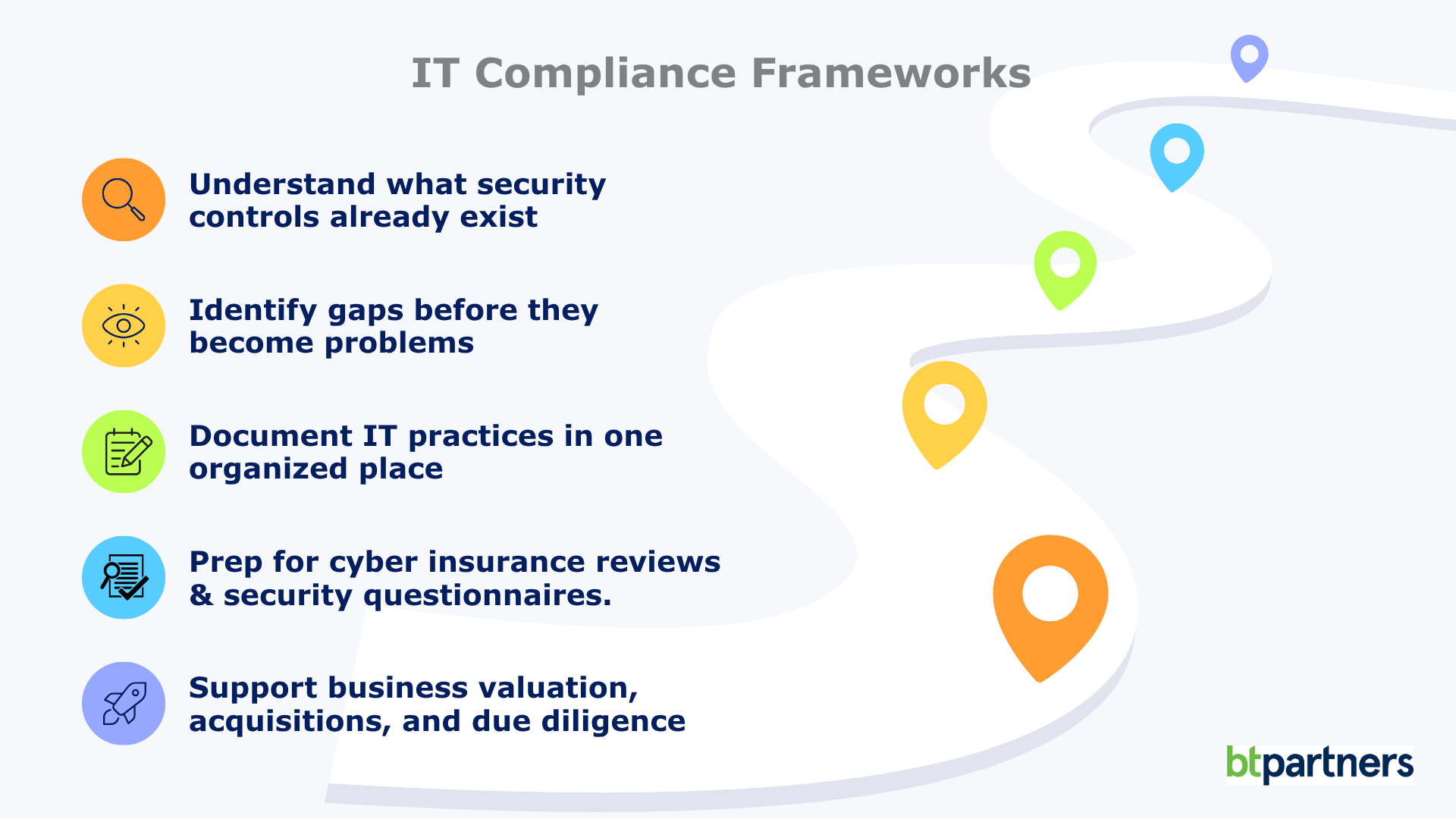
- Understand what security controls already exist.
- Identify gaps before they become problems.
- Document IT practices in one organized place.
- Prepare for cyber insurance reviews and customer security questionnaires.
- Support business valuation, acquisitions, and due diligence discussions.
Does Compliance Improve Security?
Yes, but that’s really a by-product. The goal of an IT compliance framework is to help organizations make thoughtful, consistent decisions about how they manage technology. For example, a framework may recommend controls like multi-factor authentication, email authentication technologies like DKIM, email security filtering, access controls, and security policies. Individually, none of these eliminate cyber risk. Together, they dramatically reduce the likelihood that a compromised system becomes a much larger business problem.
Should Every Business Pursue IT Compliance?
Not necessarily, but every business can benefit from thinking like a compliant organization. Whether you’re a part of the 71% of small and mid-sized businesses carrying some form of cyber insurance, responding to customer security questionnaires, planning for future growth, or simply trying to reduce risk, compliance frameworks provide a structured way to evaluate your IT environment. Even if you never pursue formal certification, many of the underlying best practices are simply good business.
If you’re not sure where your organization stands today with technology and IT compliance, reach out to our managed services team for help. We’re always here to help!
Windows 10 End of Life (What That Means for Your Business)
If you’re still running on Windows 10, your business is using unsupported software. Your computers won’t suddenly stop working, but they have stopped receiving the regular security updates and patches that help protect them from new threats. That’s where the risk begins. For many business leaders, this Windows 10 end of life announcement feels frustrating. [...]
Read More

Part 2: What Is the Cloud? For Business Leaders Who Don’t Have Time for Tech Jargon
While no technology is completely risk-free, cloud providers invest billions into security, redundancy, and monitoring that most organizations simply couldn’t justify building on their own. For many businesses, the bigger risk isn’t storing data in the cloud. It’s relying on aging servers sitting in a back office. In Part 1, we walked through how the [...]
Read More

Part 1: What Is the Cloud? For Business Leaders Who Don’t Have Time for Tech Jargon
The cloud isn’t a single product or destination. It’s simply a different way of delivering and accessing technology. It’s important to remember that whether it’s the right fit for your business depends far more on your needs than on the latest trend. The cloud has become one of those business buzzwords that everyone recognizes but [...]
Read More