
June 3, 2021
AI Plays the Leading Role in Outlier Detection

Outlier Detection. While it sounds a bit like the next TV crime drama — it’s actually closer to a reality show. An outlier is an element of a data set that distinctly stands out from the rest of the data (the black sheep of the family). Outlier detection is simply the identification of these rare items, events, or observations. In business, we speak about outlier detection predominately as a way to catch potential errors and identify risks. It’s difficult to do, mainly because businesses generate so much data. Finding the one little thing that’s not like the other can end up being a full-time job – but that was before Artificial Intelligence (AI) entered the scene.
Mistakes Happen. A lot.
You may have heard that Blockbuster turned down offers to buy Netflix back in 2000. What if Blockbuster was missing a zero on one of its projections? How about the Mars orbiter that’s lost in space due to a math error by Lockheed engineers? Or the time when Bank of America overstated its working capital by $4 billion due to an accounting error?
These are extreme examples of course, but routine accounting errors are commonplace. Customer interviews have shown that 10-20% of journal entries typically need adjustment after being posted to the general ledger. These adjustments require extra staff time to find, correct, and document.
In a typical organization, month-end is the time when errors and omissions are sought and caught as reports are printed and journals are scrutinized. When outlier detection is only performed once a month, it jeopardizes the validity of your business data for the rest of the month. If an error was made shortly after the period close, it might not be detected for three or four weeks. Meanwhile, you were making decisions based on bad data.
Catch Them While You Can
AI has made enough news recently that it’s tempting to think there’s nothing it cannot do. While plenty of tasks are better left to human eyes and hands, business data outlier detection is not one of them. AI is, in fact, the ideal outlier detector.
Accounting applications like Sage Intacct are leveraging AI in ground-breaking and innovative ways. Sage is delivering on the concept of the Intelligent Organization by incorporating functionality like Sage Intacct Budgeting and Planning and Outlier Detection for General Ledger. Sage Intacct’s Outlier Detection uses the power of AI to catch potential errors and risks all throughout the month — not just at month end. It reduces the cost associated with catching and correcting errors, and significantly, it enables finance teams to trust their financial information sooner — without having to wait for the close.
Sage Intacct Outlier Detection uses your organization’s historic transaction patterns to review transactions during the approval cycle and catch transactions that don’t match or seem unusual and send alerts about them to approvers, who can then decide what action to take. It does this with the help of artificial intelligence (AI) and machine learning (ML). The tool “learns” over time, getting smarter and helping to continually improve overall data accuracy for your company.
What Can Better Data, Earlier, Do for Your Company?
Access to accurate, real-time data can help you achieve your organizational objectives and deliver your business strategy. Better business data informs decision making, helps you identify opportunities and trends, allows you to provide better products and services, improves internal workflows, and creates additional revenue.
Outlier detection, like that in Sage Intacct, builds confidence in your business data, powers smart decision making, and helps catch anomalies before they skew your vision. It’s one of the most practical and strategic use cases for AI we’ve seen.

Is Your Business Falling Behind on AI, or Moving Too Fast?
AI in the workplace can sometimes manifest as a solution looking for a problem, which might tempt us to fast-forward through security and safety controls because the results look so promising. Before implementing any AI solution, organizations should establish a few foundational guardrails: clear acceptable use policies, human oversight of important decisions, and confidence that [...]
Read More
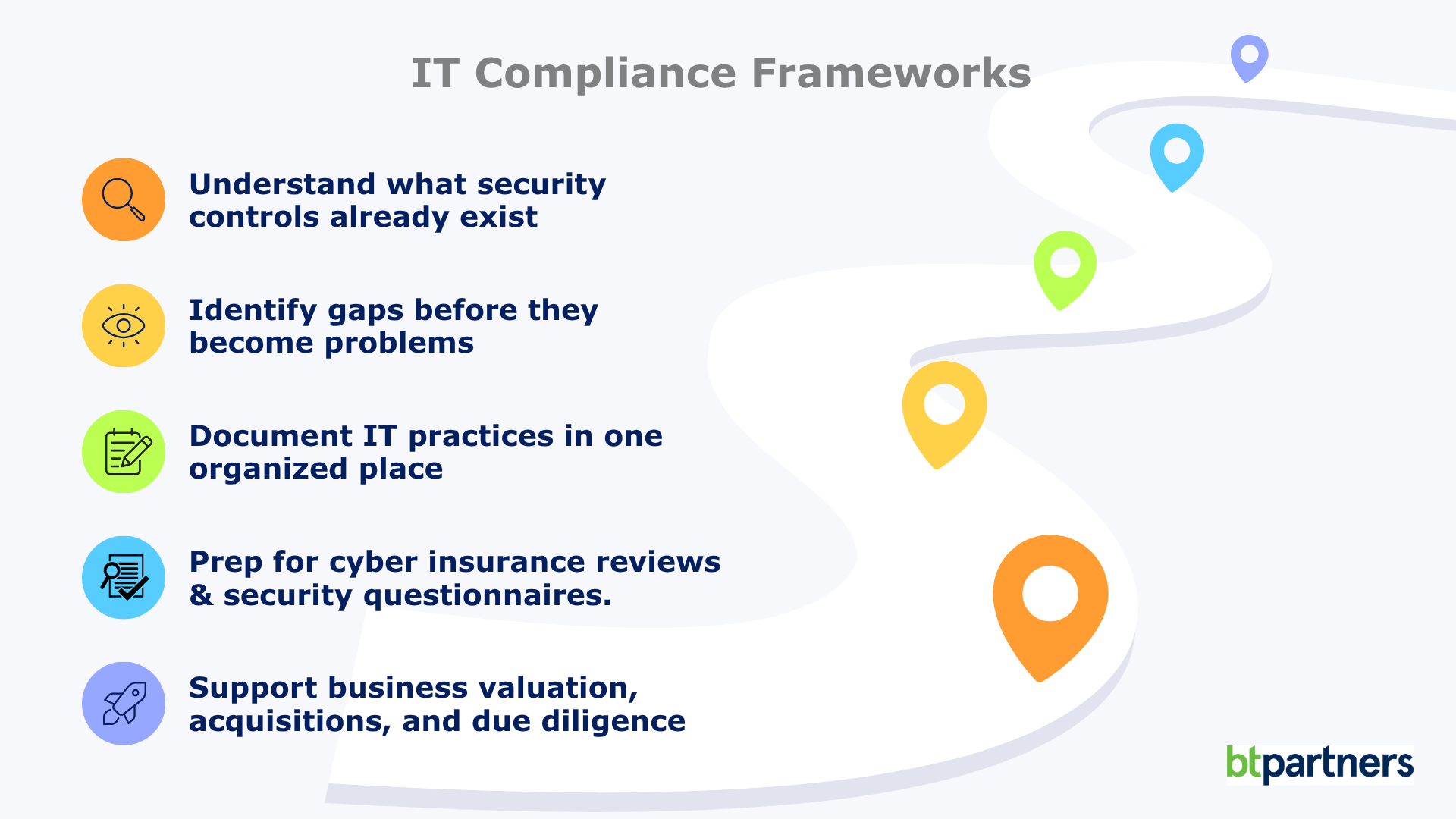
IT Compliance Frameworks Explained: What They Are and Whether Your Business Needs One
Firewalls, multi-factor authentication, passkeys, cyber insurance questionnaires, third-party security assessments. The rules around IT compliance change every year. Unlike plumbing or electrical systems, technology never really stands still. The security best practices that protected businesses a decade ago often aren’t enough today, and that’s exactly why IT doesn’t rely on fixed rulebooks the way many [...]
Read More

Windows 10 End of Life (What That Means for Your Business)
If you’re still running on Windows 10, your business is using unsupported software. Your computers won’t suddenly stop working, but they have stopped receiving the regular security updates and patches that help protect them from new threats. That’s where the risk begins. For many business leaders, this Windows 10 end of life announcement feels frustrating. [...]
Read More