

November 26, 2019
How Accounting Has Evolved In The Last Decade

While the fundamentals of accounting remain mostly unchanged, the interpretation of those fundamentals and the actual processes of accounting have been rapidly evolving. Technology has changed almost every facet of most industries and accounting is no different. Here are a few major ways that accounting has changed in the last 10 years.
Record management
Managing your company’s records has likely become much easier over the past decade with advanced technologies making it easier to store data electronically and pull files up with a few clicks of a button. Using manual filing systems and having excessive amounts of paper documents to store and sift through is a thing of the past. If you are still manually filing copies of paper checks, it’s worth asking why, and starting to research other options!
Software
10 years ago your average accounting software was an out of the box, one size fits all solution. These solutions were mostly installed on premises and required regular, manual upgrades, often with a lot of testing time associated with those upgrades. They were better than documenting everything on paper by hand, but maintaining those systems could be a time-consuming process. While those solutions still exist, they have progressed. Over the past 10 years some really comprehensive cloud based solutions have emerged, making a lot of accounting system maintenance a thing of the past. Software solutions such as Sage Intacct are making accounting easier for companies just like yours.
Efficiency
With the advancements in accounting solutions, there has also been an evolution in efficiency. The processes that the accounting department is responsible for are historically time-consuming. Improvements in payables and receivables processes, as well as new automation solutions, have helped increase efficiency. The typical manual processes of accounting can be a thing of the past if you invest in the right solution.
Costs
With increased efficiency and decreased man-hours, cost savings in the new era of accounting is inevitable. Not only are you saving money on payroll and administrative costs, but you can also save money on things like late fees, missed payments, and other errors that can occur with a manual accounting solution like the ones that were more common a decade ago.
Cloud
You may not know this, but cloud computing was actually invented in 1960. Accountants have been slower to embrace the cloud than other professions, but over the past 10 years we have seen a massive shift to the cloud that will only continue to pick up steam.
Rules and Regulations
With advancements in technology and changes in the economy, necessary new rules and regulations have been put into place. With the recession that took place about a decade ago, the Dodd-Frank act was adapted to protect consumers and the economy from another recession. Other state and local tax regulations, such as Wayfair and ASC 606, were also put into place over the last 10 years.
These changes have had an understandable impact on small and large businesses all across the country.

Is Your Business Falling Behind on AI, or Moving Too Fast?
AI in the workplace can sometimes manifest as a solution looking for a problem, which might tempt us to fast-forward through security and safety controls because the results look so promising. Before implementing any AI solution, organizations should establish a few foundational guardrails: clear acceptable use policies, human oversight of important decisions, and confidence that [...]
Read More
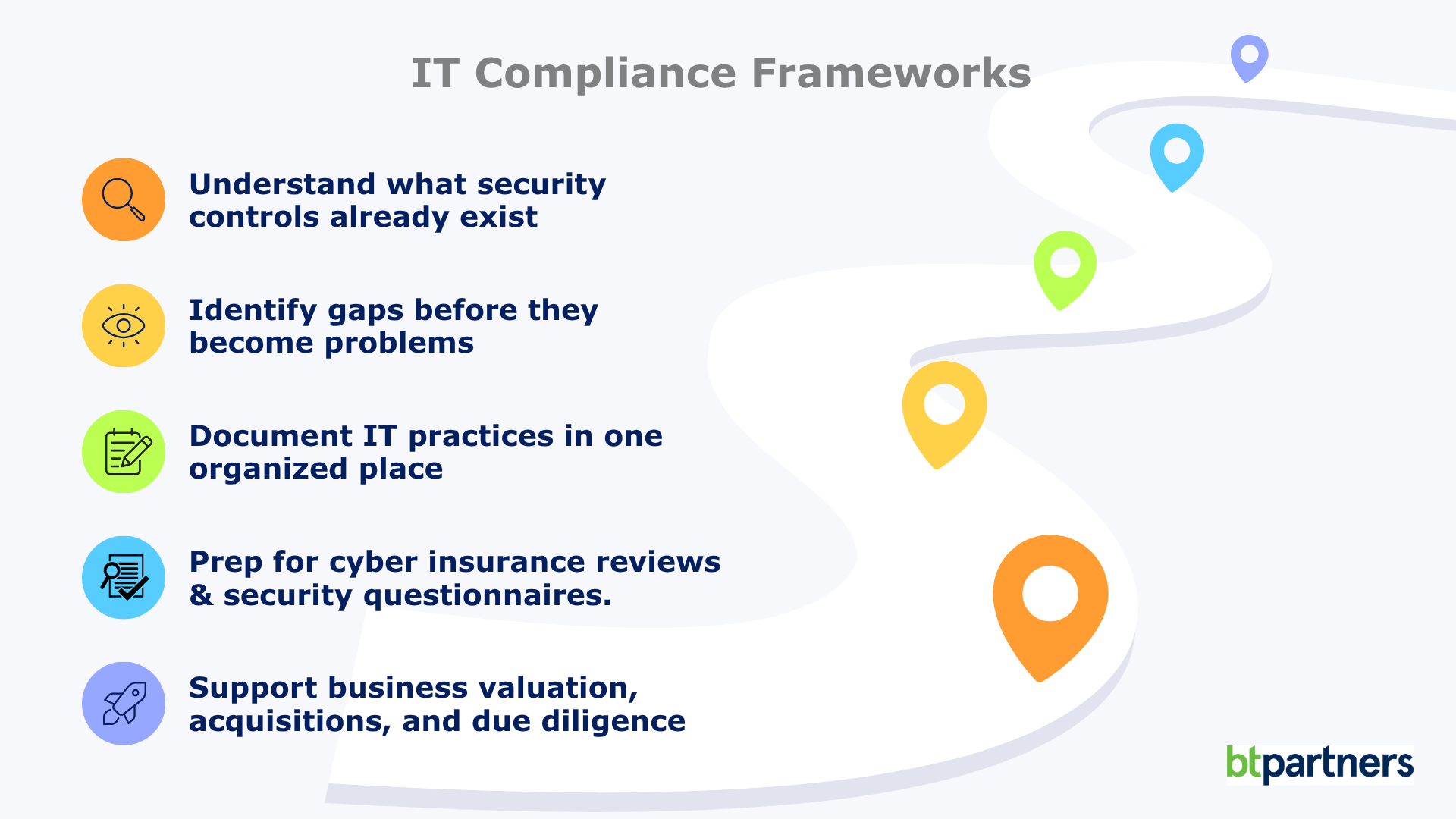
IT Compliance Frameworks Explained: What They Are and Whether Your Business Needs One
Firewalls, multi-factor authentication, passkeys, cyber insurance questionnaires, third-party security assessments. The rules around IT compliance change every year. Unlike plumbing or electrical systems, technology never really stands still. The security best practices that protected businesses a decade ago often aren’t enough today, and that’s exactly why IT doesn’t rely on fixed rulebooks the way many [...]
Read More
Windows 10 End of Life (What That Means for Your Business)
If you’re still running on Windows 10, your business is using unsupported software. Your computers won’t suddenly stop working, but they have stopped receiving the regular security updates and patches that help protect them from new threats. That’s where the risk begins. For many business leaders, this Windows 10 end of life announcement feels frustrating. [...]
Read More