

June 25, 2026
What Do We Know About Sage Intacct’s Five AI Agents? We walk through them and highlight what matters.

In our last post, we ran through the cast. This time, we’re looking at them up close, using real AI agent examples, to reveal what each agent actually does, what it doesn’t do, and where it really sits in the release cycle. We’ll start with the most mature and end with the most ambitious, using real-world AI agent examples from Sage Intacct.
The following AI agent examples show where Sage’s AI strategy is already delivering value and where it’s still evolving.
1. The AP Automation Agent — the most mature of the group
The first of our AI agent examples is also the most mature. Of the five, this is the one is the workhorse. It reads incoming bills (PDF, image, email attachment), creates draft AP transactions, matches POs to invoices at the line level, and flags duplicates and likely errors before they hit the GL. The 2026 R1 release added AI-powered line-level matching, which closes one of the most stubborn gaps in AP automation: when a three-line invoice needs to be matched against a five-line PO and the system can’t rely on a neat header-level match.
What it doesn’t do: It won’t replace your AP team. It changes the work from data entry to review. Edge cases (unusual vendor terms, partial deliveries, mismatched tax handling) still come back to a human.
Release status: Shipped and in production. The most “we use this every day” of the five.
If there’s a “first AI move” in the Sage Intacct stack, this is it.
2. The Sage Time Assistant — built for time-driven businesses
The Time Assistant pulls signals from email, calendars, geofenced mobile activity, and computer use, then suggests timesheet entries you can review and approve. The hard part of time tracking isn’t the entry. It’s the remembering.
For services firms, construction, agencies, grant-funded projects, this is genuinely useful. Recovered billable hours go straight to the top line, and the friction of capturing time is the single biggest reason it doesn’t get captured.
What it doesn’t do: It doesn’t add much value if you don’t bill by project or by the hour. If you’re a product company, this is a feature in search of a problem.
Release status: Generally available and has been improving steadily.
Whether you should turn it on depends entirely on your business model. We’ll get into that in the next post.
3. The Close Agent — strong workflow, AI still developing
The Close Agent has two distinct parts:
The workflow layer — the Close Workspace, task tracking, handoffs, subledger reconciliation guidance — is generally available in the US and is a real improvement over the 47-tab Excel checklist most teams are running. If your close process today is “Sarah knows what to do and we trust her,” this gives you a system that doesn’t depend on Sarah being there.
The AI layer on top (Close Analytics, Variance Analysis, Subledger Reconciliation Assistant) is newer. Close Analytics was introduced in 2026 R1 as part of the Early Adopter program. It’s promising, but it’s not yet the headline act.
What it doesn’t do: It won’t close your books for you. The Close Agent organizes work, surfaces variances, and suggests next steps. The work still happens, and the controller still controls.
Release status: Live in the US; AI components at various stages.
The Close Agent says a lot about where Sage is overall: strong foundation, AI layered in steadily, real but uneven (so far).
4. The Assurance Agent — an extra review layer for journal entries
This one watches journal entries in real time and flags ones that look unusual based on historical patterns: wrong account, unexpected dimensions, dollar amounts that don’t match prior behavior. Sage’s number is 15 million+ transactions scanned per week across its customer base. That’s a lot of pattern recognition.
The question worth asking is what the Assurance Agent is catching that your existing controls aren’t. If your journal entry review process is informal, this provides a useful additional check. If you’ve already got tight segregation of duties, multi-level approvals, and an actual reviewer reading every material journal entry, the marginal value is smaller. The Assurance Agent is also better at flagging anomalies than at catching well-disguised fraud, which by definition tries to look normal.
What it doesn’t do: It won’t replace internal controls. Anyone selling it that way should be politely redirected.
Release status: Live, available now.
More than any other agent on the list, the value depends on what you’ve already got in place.
5. The Finance Intelligence Agent — the one that matters most over five years
Of all the AI agent examples we’ve covered, this is the one with the biggest long-term potential. We saved this for last because it’s the one that ties everything else together. The Finance Intelligence Agent is the natural-language layer on top of Sage Intacct. Ask it a question in plain English, and it retrieves relevant Intacct data, surfaces an answer, and shows the reasoning behind it. Sage has also described it as part of a broader orchestration layer across its AI ecosystem.
Sage announced an important expansion at Sage Future in April. The Finance Intelligence Agent can now take action, not just answer questions. Drafting payment reminders, preparing approvals, surfacing exceptions, all within existing workflows, with a human approving the final move. Every action is logged. Every recommendation shows its work. Sage is calling this a “glass box” approach to AI, and in a finance context, that’s the right framing.
What it doesn’t do yet: It doesn’t quite live up to its full potential. The Finance Intelligence Agent is in phased rollout, with broader availability later in 2026. How well it performs in your environment depends heavily on your data. You’ll need clean dimensions, consistent coding, well-structured customers and vendors.
Release status: In phased release.
It also opens the door to Sage’s new Agent Marketplace, where partners (us included) can build specialized agents on Sage’s platform. That’s a longer story for another day, but worth knowing it’s coming.
What’s next?
Five agents, five very different states of readiness. These AI agent examples show just how different each agent’s level of maturity really is. In the next post, we’ll get specific about what to do with all this: which to turn on, which to wait on, and what to push back on when someone tries to sell you the whole stack.

Is Your Business Falling Behind on AI, or Moving Too Fast?
AI in the workplace can sometimes manifest as a solution looking for a problem, which might tempt us to fast-forward through security and safety controls because the results look so promising. Before implementing any AI solution, organizations should establish a few foundational guardrails: clear acceptable use policies, human oversight of important decisions, and confidence that [...]
Read More
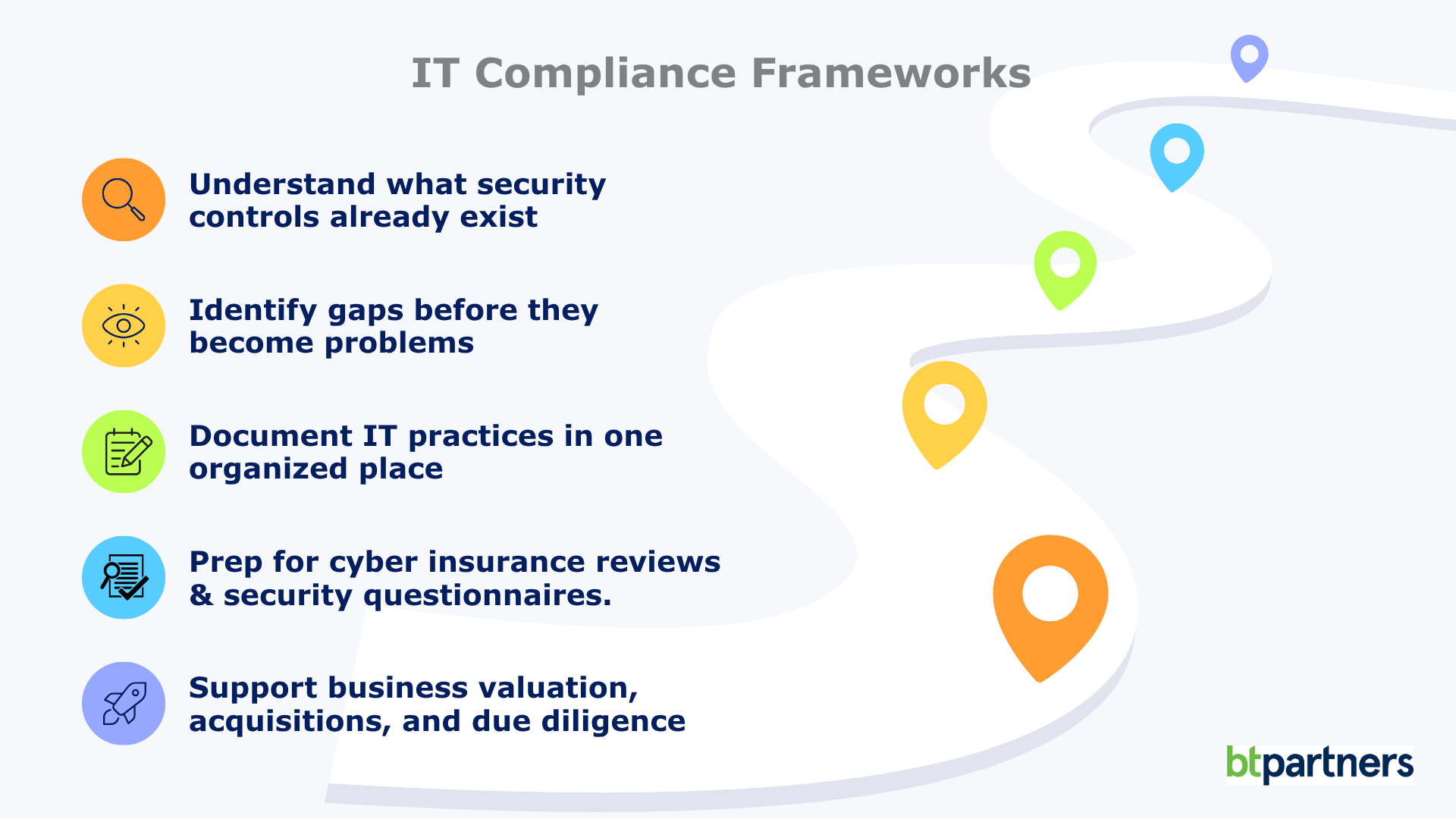
IT Compliance Frameworks Explained: What They Are and Whether Your Business Needs One
Firewalls, multi-factor authentication, passkeys, cyber insurance questionnaires, third-party security assessments. The rules around IT compliance change every year. Unlike plumbing or electrical systems, technology never really stands still. The security best practices that protected businesses a decade ago often aren’t enough today, and that’s exactly why IT doesn’t rely on fixed rulebooks the way many [...]
Read More

Windows 10 End of Life (What That Means for Your Business)
If you’re still running on Windows 10, your business is using unsupported software. Your computers won’t suddenly stop working, but they have stopped receiving the regular security updates and patches that help protect them from new threats. That’s where the risk begins. For many business leaders, this Windows 10 end of life announcement feels frustrating. [...]
Read More